Why the trades are actually different
The instinct that “a locksmith is a locksmith” comes from the trade’s pre-1990s history, when most locksmiths did handle both home locks and vehicle keys. That changed permanently when vehicles started shipping with electronic immobilizer systems in the late 1990s. Modern automotive work requires diagnostic equipment that costs $15,000-$40,000 to assemble (Autel IM608, AVDI, Xhorse VVDI key tools, BENCH/BOOT programming kits) and a continuous-learning commitment to keep up with each model year’s new encryption standards. Residential locksmithing requires a fundamentally different toolset (pin tumbler kits, lock-pinning vises, deadbolt installation tooling, master-key calculation software) and a different knowledge base (ANSI/BHMA grade standards, building code, ADA accessibility, fire-code egress requirements).
The credentialing reflects the divergence. ALOA’s certification ladder includes the general progression (Registered Locksmith → Certified Registered Locksmith → Certified Professional Locksmith → Certified Master Locksmith) but adds the Master Automotive Locksmith (MAL) as a separate automotive-specialist designation. A locksmith can hold CML without MAL (residential/commercial expert who doesn’t do automotive) or MAL without CML (automotive specialist who doesn’t do residential). The most accomplished operators may hold both, but they’re rare and usually run multi-technician operations where different specialists handle different work.
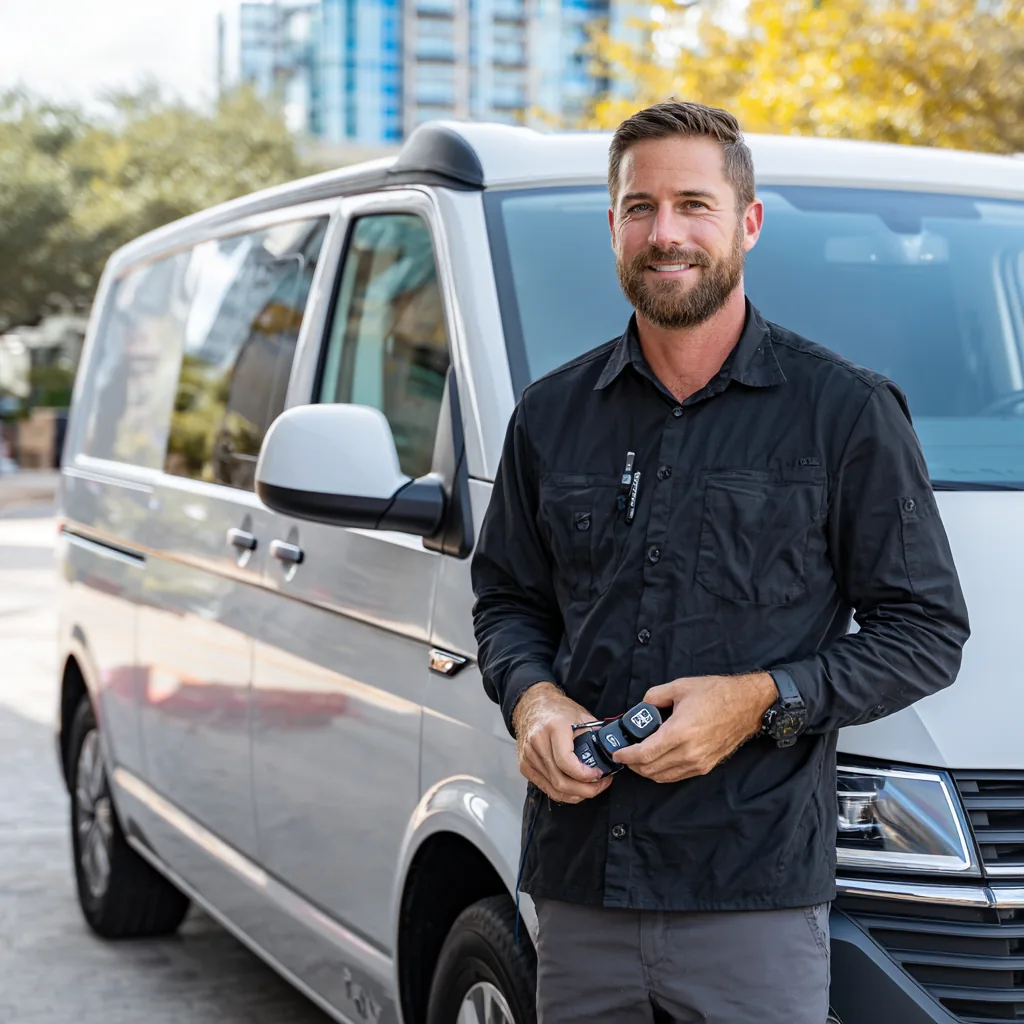
The practical implication for Grand Prairie residents: a mobile automotive locksmith van is loaded for cars, not houses. Showing up to rekey a Schlage deadbolt with the wrong toolset is at best slow and at worst damages the lock. The reverse is equally true — a residential specialist with no transponder programming equipment can’t make your 2018 Toyota Camry key work even if they can cut the physical blade.
What a residential locksmith actually does
Rekeying. Replacing the pin stack inside an existing lock cylinder so a different key works, while the old key no longer does. Most common after moving into a new home, after a security incident, or after losing keys. A residential rekey typically takes 10-20 minutes per lock and costs $25-$50 per lock plus a trip fee.
Lock installation. Mounting new deadbolts, knob/lever sets, or smart-lock systems on doors. Includes boring the door if needed, installing the strike plate, and ensuring proper alignment. Costs depend on the lock type — basic deadbolt installation: $50-$100 labor plus the lock; smart-lock installation: $80-$150 labor.
House lockout entry. Non-destructive entry to a locked home, typically using lock-picking, bumping (in some cases), or single-pin manipulation. Reputable residential locksmiths verify the homeowner&rsquo>s identity before opening — usually with a photo ID matching the address.
Master-key systems. Designing a hierarchy where different keys open different lock sets (apartments, office suites, hotel-style systems). Requires master-key calculation and pinning expertise; this is where the residential/commercial trade’s technical depth lives.
Smart lock installation and setup. Schlage Encode, Yale Assure, August, Kwikset Halo, and similar Wi-Fi/Bluetooth-enabled residential smart locks. Includes mounting, app setup, and integration with home automation platforms. This is a growing residential specialty.
Security consulting. Higher-end residential locksmiths advise on lock grades (BHMA grading standards), deadbolt placement, strike-plate hardening, and door reinforcement. This consultative work is well-aligned with insurance and home-security best practices.
What a mobile automotive locksmith does (and why we’re a separate trade)
Automotive locksmithing in 2026 is dominated by electronic work, not mechanical. Key cutting is still part of it (laser/sidewinder cutting for European vehicles, traditional cuts for older mainstream), but the bigger share of every service call is now transponder/smart-key programming — pairing the chip in the key or fob to the vehicle’s immobilizer module via the OBD-II diagnostic port. This requires per-manufacturer software, dealer-level diagnostic equipment, and (for post-2010 vehicles) NASTF VSP credentials to access OEM-secure key data.
Beyond programming, automotive work includes vehicle lockout entry (non-destructive opening of locked vehicles using wedges and long-reach tools — a different skill set from residential picking), ignition cylinder repair and key extraction (mechanical work specific to vehicle ignition assemblies), and module-level programming for advanced cases (ECU/ECM/BCM/airbag/instrument cluster — work that essentially didn’t exist in residential locksmithing).
The continuing education burden is real. Each model year brings new encryption layers — BMW’s shift from CAS3 to CAS4 to FEM to BDC, Mercedes-Benz’s ESL/EIS pairing changes, Toyota’s H-chip and DST-AES migrations, the introduction of Tesla’s phone-key system, Rivian’s key-card approach. A working automotive locksmith spends 50-100 hours per year on continuing education to stay current. Residential locksmithing changes more slowly — pin-tumbler mechanics haven’t fundamentally changed since the 1850s.
When you need each — a practical guide
Call a residential locksmith if you need to: rekey your home after moving in, change locks after a security incident, install a new deadbolt or smart lock on your home, get back into a house you’re locked out of, set up a master-key system for a rental property or office, or upgrade your home’s lock grade for insurance/security reasons.
Call a commercial locksmith if you need to: install or service exit hardware (panic bars, fire-rated doors), set up an access-control system (key fob entry, keypad systems), service a safe or vault, design a master-key system for a multi-unit building, or handle a commercial-grade rekey after employee turnover.
Call a mobile automotive locksmith if you need to: replace a lost or broken car key, program a new key fob or smart key, get into a locked vehicle, repair an ignition cylinder that won’t turn, extract a broken key from the ignition, or originate a new key when you’ve lost all of them.
If you’re unsure which trade you need, the simplest decision rule: if the problem is at your vehicle, call an automotive locksmith. If the problem is at your home, call a residential locksmith. Operators who claim to do both at a high level are uncommon — verify by asking about specific scope items relevant to your situation.
How to find a Grand Prairie residential locksmith (since we don’t offer that service)
Honest reality: we’re an automotive-only operation. If you found this article searching for residential help, here’s how to find a reputable residential locksmith in the Grand Prairie / DFW area.
Use the ALOA member directory. ALOA.org maintains a public member directory. Filter for Texas, then Grand Prairie or DFW. ALOA members hold one or more certifications (RL, CRL, CPL, CML) — confirming a basic competency floor.
Check BBB-accredited residential locksmiths. The Better Business Bureau tracks complaint history and accreditation for residential locksmiths in the DFW market. Anyone with a high complaint count or a recent rating downgrade is worth avoiding.
Ask about specific scope before authorizing service. The same vetting checklist that works for automotive locksmiths (credentials, written price quote before dispatch, specific year/make/model capability) translates: ask the residential locksmith about ANSI/BHMA grade of locks they install, whether they carry liability insurance, and what their written quote for your specific job is.
Watch for the same scam patterns. Per BBB locksmith scam reports, bait pricing and aggressive upfront-payment demands appear in residential just as they do in automotive. The defensive playbook is identical.
The deeper reason this distinction matters for trust
When a locksmith claims they do “everything” — residential, commercial, automotive, safe work, all at the same high tier — they’re usually telling one of two stories. Either they’re a sales-and-dispatch front-end that subcontracts to specialists (with markup and quality variance), or they’re a generalist who handles each trade at a basic level but doesn’t have the depth for complex work. Neither is necessarily fraudulent, but both are misleading framings that hurt customers when the actual specialty work shows up.
Honest specialists declare their scope. We do automotive. A residential-focused operator does homes and offices. A commercial specialist does building access systems and master-key planning. Operators who specialize tend to have deeper equipment, more current continuing education, and faster turnaround within their scope. The trade-off — they can’t help with adjacent work — is more than offset by the quality within scope.
Per the Salesforce State of Service research, customer trust correlates more strongly with first-call resolution than with breadth of service offering. A specialist who solves your specific problem on the first call beats a generalist who solves it eventually but partially. The discipline of declaring “we don’t do that” is, paradoxically, what makes a specialist trustworthy.
A Real-World Example
Operator: A Grand Prairie homeowner who needed (1) a spare smart key for a 2017 Mercedes-Benz GLC and (2) all the house deadbolts rekeyed after moving in. Started with one search: "locksmith Grand Prairie TX."
Before:
- Initial search returned a mix of automotive specialists, residential specialists, and "we do everything" generalist listings.
- Customer called a generalist first. Quoted $185 for the Mercedes key (which was too low — the actual all-in for a 2017 GLC EIS-paired smart key is $400-$600). Quoted $150 for "complete house rekey" without seeing the locks.
- When the generalist arrived, they couldn't program the Mercedes smart key (didn't have EIS pairing tools), and the house rekey quote turned into $40 per lock plus a trip fee — closer to $250 total.
What changed:
Customer canceled the generalist, took the time to find two specialists: an ALOA-MAL automotive locksmith for the Mercedes key, and an ALOA-CML residential locksmith for the house rekey. Both gave written quotes in advance. Both arrived prepared with the right toolset.
Results:
- Mercedes GLC smart key: $475 all-in (automotive specialist, 95 minutes on-site, key programmed and verified)
- House rekey (4 deadbolts): $185 all-in (residential specialist, 50 minutes on-site)
- Total: $660 — vs. an estimated $700-$1,000+ if the original generalist had finished both jobs at their actual capability tier with no programming completion on the car
- More importantly: both jobs completed in single visits with no scope surprises
Net: The single-search instinct produced a frustrating false start. The specialist-per-trade approach took 10 extra minutes of vetting and produced a clean outcome. This pattern is repeatable: specialists outperform generalists within their declared scope, consistent with the first-call-resolution research across service industries.
What Experts Say
“The trades diverged 25 years ago when vehicles got electronic immobilizers, and the gap has only widened. A locksmith who tries to maintain top-tier capability in both residential and automotive is signing up for 200+ hours of continuing education a year and $60-$80K of toolset investment. Most operators rationally specialize. Honest ones tell you so up front.”
Per ALOA’s separate certification ladders for automotive (MAL) and residential/commercial (CML), the trade body itself recognizes these as distinct specialties with different examination paths. Customers benefit by matching the specialist to the problem rather than treating all locksmiths as interchangeable.
Frequently Asked Questions
Do you do residential locksmith work too?
No — we’re an automotive-only mobile operation. If you need home lock rekeying, deadbolt installation, or any residential service, we’ll point you to the ALOA member directory or BBB to find a residential specialist in Grand Prairie. We don’t pretend to cover services we don’t.
Why don’t more locksmiths specialize like this?
Some do, but the “we do everything” framing is more common because it captures broader inbound search traffic. The downside — capability gaps that show up only after dispatch — is borne by the customer. Specialists trade away some search volume for higher quality within scope. As the trade has matured and tooling has gotten more expensive, specialization has accelerated.
How do I tell from a website whether a locksmith is really automotive or residential?
Look for specific service depth: do they list specific vehicle makes and key types (transponder, smart key, push-start), or do they list specific lock types (Schlage, Kwikset, BHMA grades)? Automotive specialists usually have content about programming, immobilizers, ECU work. Residential specialists usually have content about deadbolts, master keys, smart-lock installation. Generalists tend to have surface-level coverage of both.
Is one trade more profitable than the other?
They’re different business economics. Automotive tends to have higher per-call revenue ($150-$500+) but requires expensive specialized equipment ($25K-$40K+ tooling). Residential has lower per-call revenue ($75-$200 typical) but lower equipment costs and easier scaling via subcontractor networks. Neither is inherently more profitable — depends on volume, geography, and operator skill.
What about smart locks — is that residential or something else?
Smart-lock installation is residential locksmith work. Smart locks (Schlage Encode, Yale Assure, August, Kwikset Halo) install on doors and use Wi-Fi/Bluetooth for keyless entry. They’re fundamentally house locks with electronic actuators. Different from automotive smart keys, which are vehicle-immobilizer-paired devices. The terminology “smart” is shared but the systems are unrelated.
Where can I learn more about residential lock standards?
The <a href="https://www.bhma.org/standards/" target="_blank" rel="noopener">Builders Hardware Manufacturers Association (BHMA)</a> publishes the ANSI/BHMA grading standards that define residential and commercial lock quality (Grade 1, 2, 3). Grade 1 is commercial-duty, Grade 2 is heavy-duty residential, Grade 3 is light residential. The BHMA site is the authoritative reference.
The Bottom Line
Residential and automotive locksmithing are different trades. The shared word “locksmith” is misleading — the tools, training, certifications, and continuing education are largely independent. For automotive work in Grand Prairie, hire an ALOA-MAL with NASTF VSP. For residential work, hire an ALOA-CML or check the BBB-accredited residential listings. Specialists outperform generalists within their declared scope — a pattern documented across service industries by first-call-resolution research.
Next Steps
If you need automotive locksmith help in Grand Prairie — car keys, fobs, lockouts, ignition work — we’re an ALOA-credentialed mobile specialist. See our about page for credentials or contact us with your vehicle details. If you need residential locksmith help, use the ALOA member directory at aloa.org to find a Grand Prairie residential specialist.