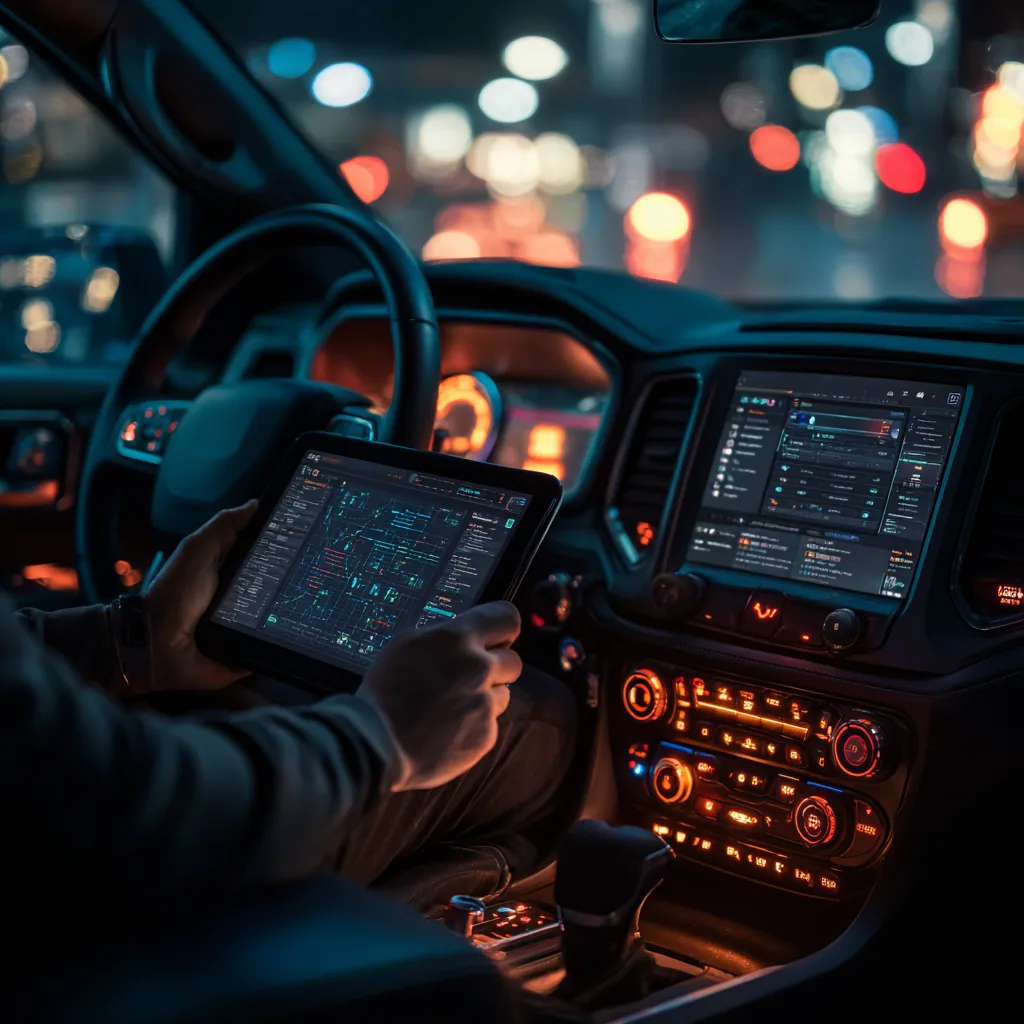
What a mobile automotive locksmith actually does
The defining trait of mobile automotive locksmithing is that the work happens at the vehicle’s location, not in a shop. The locksmith’s van is the shop. Inside, a properly-equipped automotive technician carries key-cutting machines (mechanical and laser/sidewinder), a transponder-programming unit (most commonly Autel IM608 / IM508 or AVDI), a dealer-level OBD-II diagnostic interface, key blanks for the most common vehicle makes (Toyota, Honda, Ford, GM, Hyundai-Kia, Mopar, BMW, Mercedes, etc.), and (for module-level work) BENCH/BOOT-mode programming kits.
The five core service categories: (1) Key origination and duplication — making a new key from VIN when you have no working key (origination) or copying from an existing working key (duplication). (2) Transponder/smart-key programming — synchronizing the chip in the key to your vehicle’s immobilizer module so the engine will start. (3) Vehicle lockout entry — non-destructive entry to a locked vehicle using wedges, long-reach tools, and bypass procedures. (4) Ignition repair and key extraction — fixing worn or damaged ignition cylinders, removing broken keys from cylinders, and replacing ignition assemblies. (5) Module-level programming — for advanced cases involving ECU/ECM/BCM, airbag modules, instrument clusters, and immobilizer resets after multi-key loss.
Things a mobile automotive locksmith does not do: residential rekeying, commercial master-key systems, safe opening, home lock installation, security camera installation. These are separate trades with separate credentials. An honest automotive specialist will refer you to a residential or commercial locksmith for non-vehicle work rather than try to handle it.
Modern car keys — five types and how they differ
Mechanical key (metal blade only). Older vehicles — generally pre-1998 domestic, pre-2002 import — use a purely mechanical key with no electronic component. These can be cut by a standard key-cutting machine in 5-10 minutes and require no programming. They’re becoming rare in Grand Prairie’s vehicle population but still exist on classic cars and older commercial vehicles.
Transponder key (chip embedded in plastic head). The dominant standard from roughly 1998 through 2015. The plastic head of the key contains an RFID transponder chip that communicates with the vehicle’s immobilizer module when inserted in the ignition. The metal blade is mechanical (cut to match the lock cylinder); the chip is electronic (programmed to the vehicle). Both have to be right or the engine won’t start. Cost in 2026: typically $150-$300 all-in for a routine transponder key on a mainstream vehicle.
Remote head key (transponder + integrated remote). A transponder key with the lock/unlock/panic remote buttons built into the plastic head. Common on 2005-2018 vehicles. Same programming process as a transponder key plus an additional remote-function pairing step. Cost: $180-$400 all-in.
Smart key / proximity fob (push-to-start vehicles). Dominant from roughly 2010-present on luxury and 2015-present on mainstream vehicles. No physical key blade is inserted in an ignition — the fob communicates with the vehicle wirelessly when in range, and the driver pushes a button to start. Programming is significantly more complex because the fob carries encryption and the vehicle’s immobilizer must register it through an OEM-sanctioned workflow. Cost: $250-$600 for mainstream brands, $400-$900+ for European luxury.
High-security/laser-cut and sidewinder keys. A blade profile that uses milled grooves or sidewinder cuts rather than traditional jagged teeth. Used widely on European luxury (BMW, Mercedes-Benz, Audi, Porsche, Range Rover) and increasingly on mainstream high-trim vehicles. Requires a laser/sidewinder cutting machine — equipment that not every locksmith carries. If your vehicle uses laser cuts, confirm the locksmith can cut them before authorizing dispatch.
The programming process — what happens during a service call
For a routine transponder or smart-key replacement, the process typically runs in five steps. First, vehicle identification — the locksmith confirms the year/make/model and verifies the VIN matches the registration. Second, key blank selection — pulling the correct uncut blank for your specific vehicle’s lock profile. Third, key cutting — either copying an existing working key’s pattern or originating a new pattern from the VIN’s lock code. Fourth, transponder programming — pairing the chip to your vehicle’s immobilizer module via the OBD-II port using diagnostic equipment (Autel IM608, AVDI, Xhorse VVDI, etc.). Fifth, verification — confirming the new key starts the engine, locks/unlocks the doors via remote functions, and that any existing keys still work as expected.
Time on-site varies by complexity. A duplicate transponder key (you have a working key, want a spare) on a 2012 Honda Civic: 20-30 minutes. An all-keys-lost smart-key origination on a 2018 BMW 3-Series: 90-150 minutes. A push-start origination on a 2020 Mercedes-Benz with EIS pairing: 90-180 minutes. The variance comes from the OEM workflow — some manufacturers require waiting periods (timed lockouts on the immobilizer module) that the technician has to honor, regardless of skill.
For all-keys-lost cases (you’ve lost every key to the vehicle, including the spare), the workflow gets more involved because the technician has to access OEM-secure data via the NASTF VSP gateway to obtain the key code. This is the credential that legitimately distinguishes locksmiths who can handle modern all-keys-lost cases on European luxury and post-2015 mainstream vehicles from those who can’t. The process adds time and cost but doesn’t require towing your vehicle to a dealer.
Vehicle scope — what brands and years a Grand Prairie locksmith should cover
Practical coverage expectations for a Tier 2-or-better automotive locksmith in DFW: Asian mainstream (Toyota, Honda, Nissan, Hyundai, Kia, Mazda, Subaru, Mitsubishi) — full coverage from roughly 1998 through current model year, including all-keys-lost. Domestic mainstream (Ford, GM/Chevy/Buick/Cadillac/GMC, Stellantis/Chrysler/Dodge/Jeep/Ram) — full coverage 1998-present. European luxury (BMW, Mercedes-Benz, Audi, Volkswagen, Porsche, Land Rover/Range Rover, Jaguar) — coverage varies; a Tier 3 specialist handles all of these including 2018+ EIS-protected vehicles. European mainstream (Volvo, MINI, Fiat, Smart) — typically covered by Tier 2-3 operators. Tesla, Rivian, Lucid — emerging coverage; most use phone-key + key card rather than traditional fobs, and the workflow is OEM-specific.
The list of common exceptions: vehicles requiring proprietary OEM tools that aren’t commercially available (some pre-2005 luxury vehicles, certain limited-production models), vehicles with security features the manufacturer has chosen not to share with the NASTF program (rare but happens), and vehicles where the owner can’t prove ownership (locksmiths legitimately decline to work on vehicles without registration / title match for theft-prevention reasons).
If you drive something unusual — a classic, an import-conversion, a kit car, or anything pre-1990 — ask the locksmith specifically about your year/make/model before dispatch. Some operators have niche capabilities for older or imported vehicles that the typical Tier 2 generalist doesn’t.
Pricing in Grand Prairie — realistic 2026 benchmarks
Mobile automotive locksmith pricing in DFW for 2026 runs roughly 35-60% below dealership service-department pricing for equivalent work, per AAA’s vehicle ownership cost research. The savings come from the locksmith’s lower overhead (no service-bay rent), no required tow to dealer, and a more streamlined workflow than a dealer’s service department.
Routine transponder key (you have a working key, want a spare). 2012 Toyota Camry: $135-$185 all-in. 2016 Honda Civic: $145-$195. 2015 Ford F-150: $165-$225. Compared to dealership equivalents: $250-$450 for these vehicles, plus you have to drop the car off.
All-keys-lost transponder (origination required). 2012 Toyota Camry: $200-$300. 2016 Honda Civic: $220-$300. Adds 30-60 minutes to the service time vs. duplication.
Smart key / push-start (proximity fob). 2018 Toyota Highlander: $250-$350. 2019 Honda Pilot: $280-$380. 2020 Ford Explorer: $290-$400. 2020 BMW X3: $400-$650. 2019 Mercedes-Benz GLC: $450-$800. 2020 Range Rover Sport: $500-$900+.
Ignition repair / cylinder replacement. $150-$400 depending on vehicle and whether the immobilizer system needs reprogramming.
Lockout (vehicle entry, no key work). $65-$125 typical during business hours. After-hours and outlying areas (Mansfield, far Dallas) may add a modest surcharge.
The pricing pattern that should make you skeptical: any quote dramatically below these ranges (a "$29 service call, key starting at $69") or any operator who refuses to quote a total before dispatch. Per BBB locksmith scam reports, these are the classic bait-pricing tactics — the low quoted base never includes the actual key, programming, or travel.
When to call a locksmith vs. when to call the dealer or AAA
Call a mobile automotive locksmith when: you’ve lost your car keys (single or all), your key fob has stopped working, you’re locked out of your vehicle, your key is broken or stuck in the ignition, your ignition cylinder has worn out and the key won’t turn, you need a spare or replacement key cut and programmed, you want to avoid a tow to the dealer for any of the above.
Call your dealer when: the work is covered under a current warranty (most warranty work has to go through the dealer to remain covered), you need a programming-only service for a key the dealer specifically issued, or you have a vehicle/situation where you’ve confirmed the dealer is the only viable path (rare on mainstream brands, occasional on very-new model years before aftermarket tooling has caught up).
Call AAA or a tow service when: the vehicle has a mechanical problem unrelated to the keys, you need a jump-start, you have a flat tire, or the vehicle needs to be moved to a service center. AAA roadside also offers basic lockout service in many regions, but for key work itself (programming, replacement) you’ll need a locksmith or dealer.
For most automotive key situations in Grand Prairie, the locksmith path is faster and significantly cheaper than the dealer path. Per Salesforce’s service-industry research, customer-rated time-to-resolution is the single strongest predictor of service satisfaction — and mobile locksmiths typically deliver same-hour resolution where dealers deliver next-day-or-later.
A Real-World Example
Operator: An Arlington commuter, 2019 Honda CR-V, lost both keys (had a single smart fob plus a metal valet key). Discovered the loss at 7:30am Monday morning before work.
Before:
- Honda dealership quote: $475 for the proximity smart key + programming, plus a $125 tow to the service bay, plus a 2-3 day turnaround (dealer service department was booked).
- Time without a working vehicle if going dealer route: estimated 3 working days.
- Practical impact: missed work or rideshare costs of $80-$150/day.
What changed:
Customer called a mobile automotive locksmith at 7:45am. Vehicle year/make/model confirmed, all-in price quoted in writing within 5 minutes ($385 including all-keys-lost origination and EEPROM reset). Technician arrived at the customer's home in Arlington at 8:50am. On-site work completed by 10:20am.
Results:
- Total elapsed time from call to working vehicle: 2 hours 35 minutes
- Total cost: $385 (vs. estimated $600+ all-in dealer pathway with tow)
- No vehicle downtime — customer drove to work at 10:30am, was 30 minutes late vs. an estimated 3 working days of disruption
- Both new smart fobs verified working before the technician left; old fob ID-flushed from the immobilizer so the lost fob can't start the vehicle if found
Net: Net difference: roughly $215 saved vs. dealer path plus 2.5 working days of vehicle availability preserved. The combination of mobile delivery + competent all-keys-lost workflow is precisely the use case where automotive locksmiths systematically outperform dealer service departments — confirmed by AAA’s comparative repair cost data.
What Experts Say
“The biggest misconception drivers have is that the dealer is the only option when keys are lost. For mainstream brands and most model years through current, that hasn't been true for a decade. A properly-equipped mobile automotive locksmith can do everything the dealer service department can do for the key itself — usually faster and at 40-50% lower cost.”
Per the BLS OEWS data on the locksmith occupation, the trade has grown alongside vehicle complexity precisely because aftermarket diagnostic tools (Autel, AVDI, Xhorse) have closed the capability gap between dealer service departments and independent mobile operators. The gap that remains — primarily on the most recent model years and certain limited-production European vehicles — is where the dealer path still wins, but it’s narrower every year.
Frequently Asked Questions
Does my mobile automotive locksmith have to come to my home, or can I meet them somewhere?
Either works. Most customers prefer service at their home, workplace, or wherever the vehicle is currently parked. The technician comes to the vehicle. If the vehicle is at a parking lot, roadside, garage, apartment complex, or commercial location, that's fine — as long as the vehicle is accessible and the customer can confirm ownership.
How long does a typical service call take?
Duplicate key (you have a working key, want a spare): 20-45 minutes on-site. All-keys-lost transponder: 60-90 minutes. All-keys-lost smart key: 90-180 minutes depending on the vehicle. Lockouts: 15-30 minutes. Ignition extraction/repair: 45-90 minutes. The technician can give you a more specific estimate when they confirm the vehicle.
What payment forms do automotive locksmiths accept in Grand Prairie?
Most reputable mobile operators accept cash, credit/debit cards (Visa, Mastercard, Discover, Amex via mobile readers), and sometimes Apple Pay / Google Pay / Venmo. Payment is due after the work is verified — meaning the new key starts the vehicle, locks/unlocks correctly, and any existing keys still work. Operators demanding upfront payment or deposits before dispatch are a flag per the FTC consumer-protection guidance.
Can a locksmith make a key without the original?
Yes — this is called key origination, and it's standard work for any Tier 2 or better automotive locksmith. The technician originates a new key pattern from the VIN (which is publicly visible at the base of the windshield) and programs the new key to the vehicle's immobilizer. Pre-2010 vehicles: straightforward. 2010+ vehicles, especially European luxury: requires <a href="https://www.nastf.org/vsp-registry" target="_blank" rel="noopener">NASTF VSP credentials</a> to access OEM secure key data.
What's the difference between key cutting and key programming?
Cutting is the mechanical step — shaping the metal blade so it physically fits and turns in the vehicle's lock cylinder. Programming is the electronic step — pairing the transponder chip or smart fob to the vehicle's immobilizer so the engine will recognize the key and allow starting. A modern car key needs both. Cutting alone gives you a key that opens the door but doesn't start the engine; programming alone gives you a fob that recognizes the vehicle but doesn't physically fit the lock.
Are mobile automotive locksmiths licensed in Texas?
Texas regulates locksmith companies under the Department of Public Safety Private Security Program (see the <a href="https://www.dps.texas.gov/section/private-security/private-security-program-information" target="_blank" rel="noopener">TX DPS Private Security page</a>). Beyond that baseline, the most meaningful credentials for automotive work specifically are ALOA-MAL (the trade's certification body) and NASTF VSP (for OEM key code access). Ask any locksmith you're considering for the specific credentials they hold.
The Bottom Line
A mobile automotive locksmith in Grand Prairie is the right call for the overwhelming majority of vehicle key situations — lost keys, lockouts, fob issues, ignition problems. The work happens at your location, takes 30-150 minutes depending on complexity, and runs 35-60% below dealer pricing for equivalent service. The credentials that distinguish capable from generalist operators are ALOA-MAL for general automotive locksmith competency and NASTF VSP for OEM-secure data access on modern vehicles. Pricing should always be confirmed in writing before dispatch.
Next Steps
For car key replacement, lockout, programming, or ignition work in Grand Prairie, see our car key replacement service page, key programming page, or advanced module programming page. To request service, call (214) 949-1847 or text (214) 949-1847 with your vehicle year/make/model and we’ll quote the all-in total before dispatch.