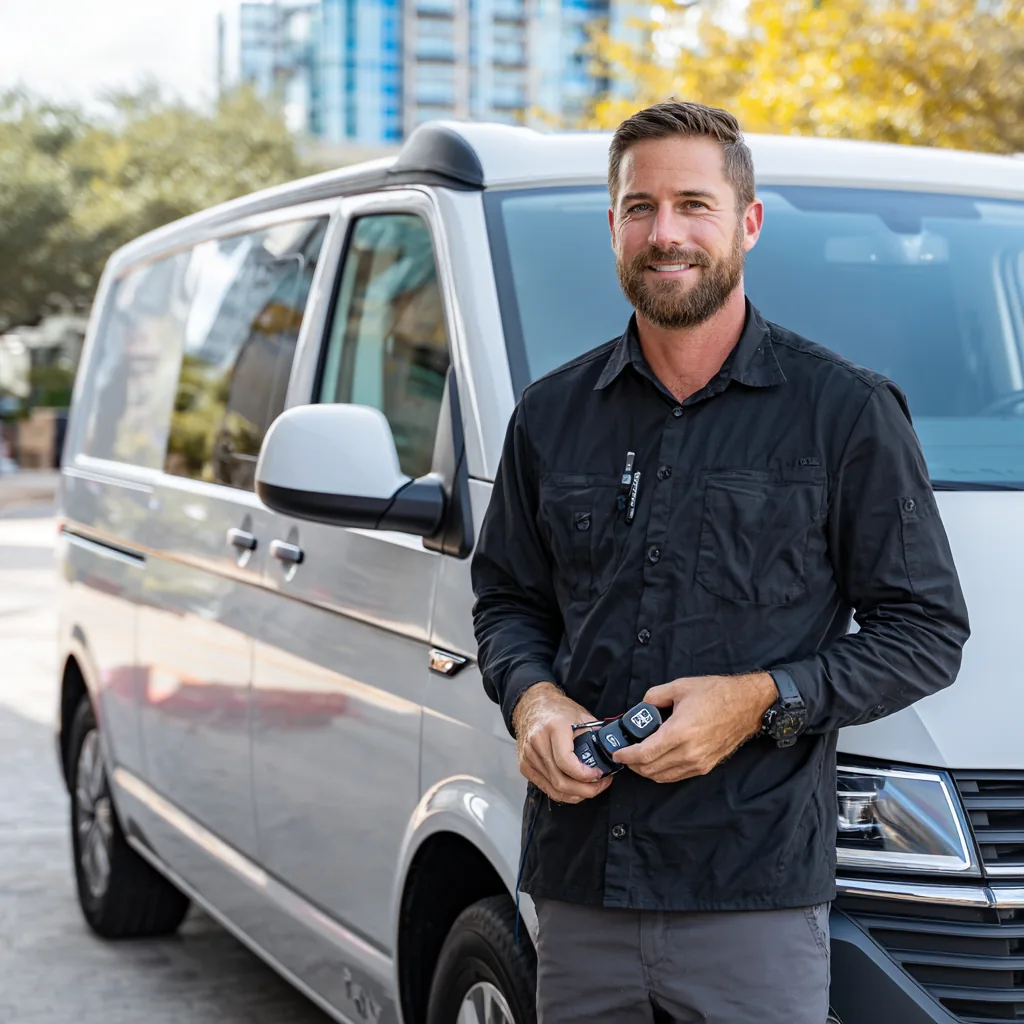
What "best" actually means for a mobile auto locksmith
The phrase “best locksmith in Grand Prairie” gets used three different ways online and only one of them maps to real service quality. The first usage is aggregator-driven — third-party directories like Yelp, Angi, and Thumbtack rank by their internal algorithms, which heavily weight ad spend, claim/response rate, and review velocity rather than technical capability. The second usage is review-aggregate driven — Google Business Profile star ratings, which correlate with customer satisfaction but don't distinguish between a residential lockout and a complex BMW all-keys-lost job. The third usage — the one that matters — is capability-driven: a locksmith who consistently solves the specific problem you have, at a price that's known up front, in a time window that's actually viable.
For an automotive customer in Grand Prairie, capability-driven means something specific. It means the technician can originate a key from VIN when you've lost all the keys, program a transponder or smart key to your vehicle's immobilizer module on-site, extract a broken key from the ignition without damaging the cylinder, and tell you the price before getting in the truck. That capability set is uncommon at the storefront-locksmith / handyman-locksmith tier. It's the operating standard for ALOA-credentialed mobile automotive specialists — and the difference shows up immediately when you compare price quotes and time-on-site.
One important framing: residential and automotive locksmithing are different trades. A great residential locksmith can pin a tumbler and rekey a Schlage deadbolt with their eyes closed but can't program a 2022 Mercedes-Benz smart key without dealer-level equipment. The reverse is also true. When you're searching for “the best locksmith in Grand Prairie,” the trade you actually need matters more than the star rating — and this article is written for the automotive case.
The credentials that matter — ALOA and NASTF VSP
Texas does not currently require a separate state-level locksmith license for automotive work, but the Texas Department of Public Safety Private Security Program regulates locksmith companies broadly under its Private Security framework. That regulatory baseline ensures basic operating compliance but doesn't speak to technical competency. The two credentials that do speak to competency are issued by national trade bodies, not the state.
ALOA-MAL (Master Automotive Locksmith). ALOA's certification ladder runs from Registered Locksmith (RL) through Certified Registered Locksmith (CRL), Certified Professional Locksmith (CPL), and Certified Master Locksmith (CML), with an automotive-specific MAL designation. The MAL exam covers transponder theory, immobilizer architecture, OEM key blade profiles, push-start system operation, and ethical practice. According to ALOA, fewer than 1,500 active MAL credentials are held nationwide — making it a meaningful signal in a market with tens of thousands of self-described “auto locksmiths.”
NASTF VSP (Vehicle Security Professional). The NASTF VSP registry is the gateway that lets independent automotive locksmiths request OEM key codes and access immobilizer secure data for vehicles where the manufacturer locks that data behind dealer credentials. VSP registration requires identity verification, criminal background check, professional references, and ongoing renewal. Without VSP, a locksmith cannot legitimately obtain dealer-level key data for many post-2010 vehicles — which means for a true all-keys-lost case on a late-model car, a non-VSP locksmith is technically operating outside the OEM-sanctioned framework.
Insurance and bonding. Beyond certification, any locksmith you authorize to work on your vehicle should carry general liability insurance and (for higher-value work) a surety bond. These are basic operating requirements and most reputable mobile operators carry them; ask for the carrier and policy number if you want to verify.
Real response time — what "fast" actually means in DFW
Response time is the single most-promised and least-measured locksmith claim. Every directory listing says “fast,” “under 30 minutes,” “15-minute response.” In practice, real response time in the Grand Prairie / Arlington / Irving corridor depends on three things: the technician's actual starting location at the moment of dispatch, DFW traffic conditions (especially I-20, I-30, and SH-360 between 7am-9am and 4pm-7pm), and whether the technician is already on a job.
Salesforce's State of Service research consistently finds that response-time consistency matters more than response-time speed for customer satisfaction — a confirmed 35-minute ETA is rated more favorably than an unconfirmed “under 20 minutes” promise that slips to 50. The honest framing for Grand Prairie automotive locksmith dispatch in 2026 is: 20-45 minutes is normal, 45-75 minutes is realistic during peak traffic or for outlying areas like Mansfield/Midlothian, and anything claiming under 15 minutes is either a dispatcher routing the call to a sub-contractor at unknown distance or a marketing claim with no operational backing.
When you call a locksmith, the right question is not “how fast?” — it's “where is your technician right now, and what's the realistic ETA after I confirm the quote?” A locksmith who answers that specifically is one who actually dispatches their own technicians. A locksmith who gives a generic “we'll be there fast” without specifics is likely routing through a national call center.
Pricing transparency — what to ask before dispatch
The single most common source of locksmith complaints in the BBB consumer database is bait pricing — a low base rate quoted by phone that bears no relationship to the final bill. The FTC's advertising guidance classifies this as deceptive practice when the advertised price doesn't include the customary cost of the service, but enforcement is light and the practice persists.
What honest automotive locksmith pricing looks like in DFW for 2026: a confirmed total before dispatch, broken down into the key blank cost, programming labor, and (if applicable) any travel or after-hours fee. For a routine transponder key replacement on a mainstream 2010-2020 vehicle, the all-in price typically lands between $150 and $300. For a smart proximity key on a 2018+ vehicle, $250-$500 is the typical range. For a European luxury all-keys-lost case (BMW, Mercedes-Benz, Range Rover, Porsche), $400-$900+ is normal because of OEM key cost and programming complexity. AAA's vehicle ownership cost data consistently shows mobile automotive locksmith services running 35-60% below dealership service-department pricing for equivalent work.
The questions to ask, in order: (1) What's the total price for my specific vehicle? (2) Is programming included? (3) Is there a separate trip fee? (4) Is there an after-hours surcharge? (5) Is payment due before or after the work is verified? A locksmith who answers all five clearly is one you can authorize. A locksmith who hedges on any of them — especially “we'll see when we get there” — is one to walk away from.
Vehicle scope — what depth of work to expect
Not every “automotive locksmith” can handle every vehicle. The honest tiering of capability across the Grand Prairie market in 2026 looks roughly like this. Tier 1 (entry): can cut a basic mechanical key and clone an existing transponder for older Asian and domestic vehicles (Toyota Camry 2005-2015, Honda Civic 2006-2014, Ford F-150 2010-2017, etc.). Tier 2 (mid): adds smart-key programming for mainstream push-start vehicles 2010-2020, plus all-keys-lost capability for that tier. Tier 3 (advanced): adds European luxury (BMW CAS/FEM/BDC, Mercedes ESL/EIS pairings, Range Rover BCM coding) and module-level work (ECU/ECM/BCM/airbag programming, instrument cluster, immobilizer reset).
For most Grand Prairie customers, Tier 2 capability is the practical floor — meaning your locksmith should be able to handle your push-start key fob or all-keys-lost case on a 2015+ mainstream vehicle without referring you to a dealer. Tier 3 capability matters when you drive European luxury, and it's worth asking specifically. The right question is “Can you originate keys for my 2019 BMW X5?” — a specific year/make/model query. A locksmith with Tier 3 capability will confirm yes and explain the process. A Tier 1-only operator will hedge or refer.
Equipment is the underlying reason for tiering. Tier 3 work requires diagnostic tools like Autel IM608, AVDI, Xhorse VVDI key tools, CGDI BMW/Mercedes, and (for ECU work) BENCH/BOOT-mode programming kits. The combined retail cost of a Tier 3 toolset exceeds $25,000-$40,000 — which is why this capability concentrates with full-time specialists rather than general locksmiths who do automotive work occasionally.
How to vet a Grand Prairie auto locksmith yourself
The five-step vetting checklist that's worked for our customers over 12 years of field service. Run all five and you'll filter out the bait operators in under five minutes of phone time.
Step 1 — Ask for the technician's credential. “Is your technician ALOA-credentialed or NASTF VSP-registered?” A legitimate operator answers yes and names the specific credentials. A vague or hedged answer is a flag.
Step 2 — Get the exact price in writing. Text or email is fine. The quote should list the key cost, programming labor, any trip fee, and the total. “Approximate” or “starting at” pricing without a confirmed total is the bait-and-switch warning sign documented across BBB's locksmith scam advisory.
Step 3 — Ask where the technician is. “Where is the technician right now, and what's the realistic ETA?” A real local operator gives you a specific area (“we're at I-30 and Belt Line, about 25 minutes”). A call-center routing operation gives a generic ETA.
Step 4 — Confirm the year/make/model capability. “Have you done all-keys-lost on a 2019 BMW X3 before?” or your specific vehicle. A specialist answers with operational detail. A generalist hedges or says “we can do anything.”
Step 5 — Confirm payment terms. Payment after verified completion (key cut, programmed, vehicle starts) — not deposits, not credit-card-on-file before arrival. Per FTC consumer advisories on locksmith scams, demands for upfront payment or aggressive credit-card-up-front tactics correlate strongly with bait-pricing operators.
If a locksmith passes all five steps cleanly, you're working with a legitimate operator. If any step fails, keep looking. There's no shortage of competent mobile automotive locksmiths in the DFW area — the vetting is purely about filtering out the few who damage the trade's reputation.
A Real-World Example
Operator: A Grand Prairie homeowner with a 2018 Mercedes-Benz C300. Single working key, requested a spare. Called three locksmiths on a Tuesday morning in late 2025.
Before:
- Locksmith A (national-listing aggregator pickup): quoted "$39 service call, key starting at $99." No total. Refused to give an all-in number on the phone.
- Locksmith B (storefront, mostly residential): said they could "probably do Mercedes" but couldn't confirm the all-keys-lost workflow capability for 2018+ EIS-locked vehicles. Hedged on price.
- Locksmith C (mobile automotive specialist, ALOA-MAL + NASTF VSP): quoted the total in writing within 90 seconds — key cost, programming, no trip fee. Confirmed the 2018 C300 EIS pairing workflow and quoted 75 minutes from dispatch.
What changed:
Customer authorized Locksmith C. Technician arrived at 38 minutes (faster than the quoted 75-minute upper bound), worked on-site at the customer's driveway, completed key origination + EIS pairing in 90 minutes total on-site. Total billed matched the written quote exactly.
Results:
- Time on-site: 90 minutes (typical for 2018+ Mercedes EIS work)
- Total price: matched the upfront written quote with no surprises
- Customer outcome: spare key in hand, both keys verified working, vehicle locked and unlocked correctly from both fobs
- Locksmith C's out-the-door price ran roughly 45% below the Mercedes-Benz dealership quote the customer had previously received
Net: When the customer compared all three quotes after the work was done, the only one that mapped to actual industry-standard pricing was Locksmith C's — confirming what AAA's repair cost research documents about mobile automotive locksmiths running 35-60% below dealer pricing for equivalent work. Locksmiths A and B weren't cheaper — they were either bait-priced or out of their capability tier.
What Experts Say
“For automotive work, the credential gap between a Tier 1 generalist and an ALOA-MAL with NASTF VSP is more than just a sticker on the side of the van. It is the difference between calling the dealer for a tow at 11pm versus having a working key in 90 minutes in your driveway. The skill ceiling matters because vehicle systems do not get simpler from here — every model year adds encryption layers.”
Per ALOA's certification standards and NASTF VSP registry requirements, the combined credential set is the industry-standard floor for legitimate access to OEM key codes and dealer-level immobilizer data on most post-2010 vehicles. Operators without both credentials can still perform older mechanical and basic transponder work, but the scope ceiling is real and ought to be disclosed up front by any honest provider.
Frequently Asked Questions
How do I verify a locksmith is actually ALOA-credentialed?
Ask for the specific credential designation (MAL, CRL, CPL, CML) and the membership status. ALOA maintains a public member directory at aloa.org. A credentialed locksmith will give you their member ID; the directory will confirm. A locksmith who claims certification but won't share the ID or whose ID isn't in the public directory is making an unverifiable claim.
Is the cheapest locksmith always the worst option?
Not always — but the cheapest <em>quoted starting price</em> often is. Bait operators advertise "$15 service call" knowing the final bill will be much higher once they're on-site. The right reference point is the total all-in price from a reputable operator (typically $150-$300 for routine transponder keys). Anything significantly below that is either a bait price or signals the operator can't actually do the work and is hoping to upsell or refer when they arrive.
Do I need a NASTF VSP-registered locksmith for my specific car?
Likely yes if your vehicle is 2010 or newer, especially for all-keys-lost cases. Pre-2010 vehicles can usually be handled without OEM-secure-data access. For 2010+ European luxury (BMW, Mercedes-Benz, Audi, Range Rover, Porsche) and many 2015+ mainstream vehicles, NASTF VSP is effectively required for legitimate origination. Ask the locksmith directly — a VSP-registered tech will confirm and explain the workflow.
What is the realistic response time in Grand Prairie?
20-45 minutes for typical Grand Prairie addresses during business hours, 30-60 minutes during DFW rush hour (7-9am and 4-7pm), and 30-75 minutes for outlying areas like Mansfield, Midlothian, or far-south Dallas. After-hours response can be similar or slightly longer depending on dispatcher availability. Any quote of "under 15 minutes" without a known technician location is almost certainly aspirational rather than operational.
Should I get a written quote before the locksmith comes out?
Yes. Always. Text, email, or written confirmation of the total all-in price (key + programming + any fees) is the single most effective protection against bait pricing. Reputable operators provide this in 60-90 seconds. Operators who refuse — saying "we'll see when we get there" — are the ones to avoid. The <a href="https://www.bbb.org/all/locksmith-scams" target="_blank" rel="noopener">BBB locksmith scam advisory</a> documents this pattern in detail.
What's the difference between a residential and an automotive locksmith?
They're different trades with different tools, training, and certifications. A great residential locksmith pins tumblers and rekeys deadbolts but typically cannot program a modern vehicle smart key. A great automotive locksmith originates and programs vehicle keys but typically doesn't install or rekey home locks. Some operators do both — but the certifications, equipment, and continuing education paths are distinct. For a car key, hire an automotive specialist.
The Bottom Line
The "best locksmith in Grand Prairie" for an automotive customer in 2026 is the operator who is ALOA-credentialed, NASTF VSP-registered, quotes a confirmed all-in price in writing before dispatch, tells you the technician's actual location and realistic ETA, and has documented capability for your specific year/make/model. Star ratings and directory rankings are downstream signals — useful but secondary. The five-step phone vetting takes about five minutes and filters out the operators who give the trade a bad reputation.
Next Steps
If you need a car key replacement, lockout, or programming work in Grand Prairie right now, we're an ALOA-credentialed and NASTF VSP-registered mobile automotive locksmith. Call us at (214) 949-1847 or text (214) 949-1847 with your vehicle year/make/model — we'll quote the all-in total before dispatch. For specific services see our car key replacement page and emergency locksmith page.
Sources cited in this article
- ALOA — Associated Locksmiths of America (Certification)
- NASTF — Vehicle Security Professional Registry
- Texas DPS — Private Security Program
- AAA — Cost of Vehicle Ownership
- Salesforce — State of Service Report
- FTC — Online Advertising and Marketing Guidance
- FTC — Consumer Locksmith Scam Advisory
- BBB — Locksmith Scam Reports