What rekeying actually means in each domain
Residential rekey. The process of changing the pin tumbler configuration inside an existing lock cylinder so a different key works, while the previous key no longer does. Inside a residential deadbolt, the lock cylinder contains a row of spring-loaded pins (typically 5-6 pins). The key’s cut pattern lifts each pin to a specific height, which aligns the “shear line” and allows the cylinder to rotate. Rekeying replaces these pins with a different set keyed to a new key cut. The mechanical process takes 10-20 minutes per lock once the cylinder is removed from the door. Tooling: a residential pinning kit, a small vise, a follower tool, replacement key pins.
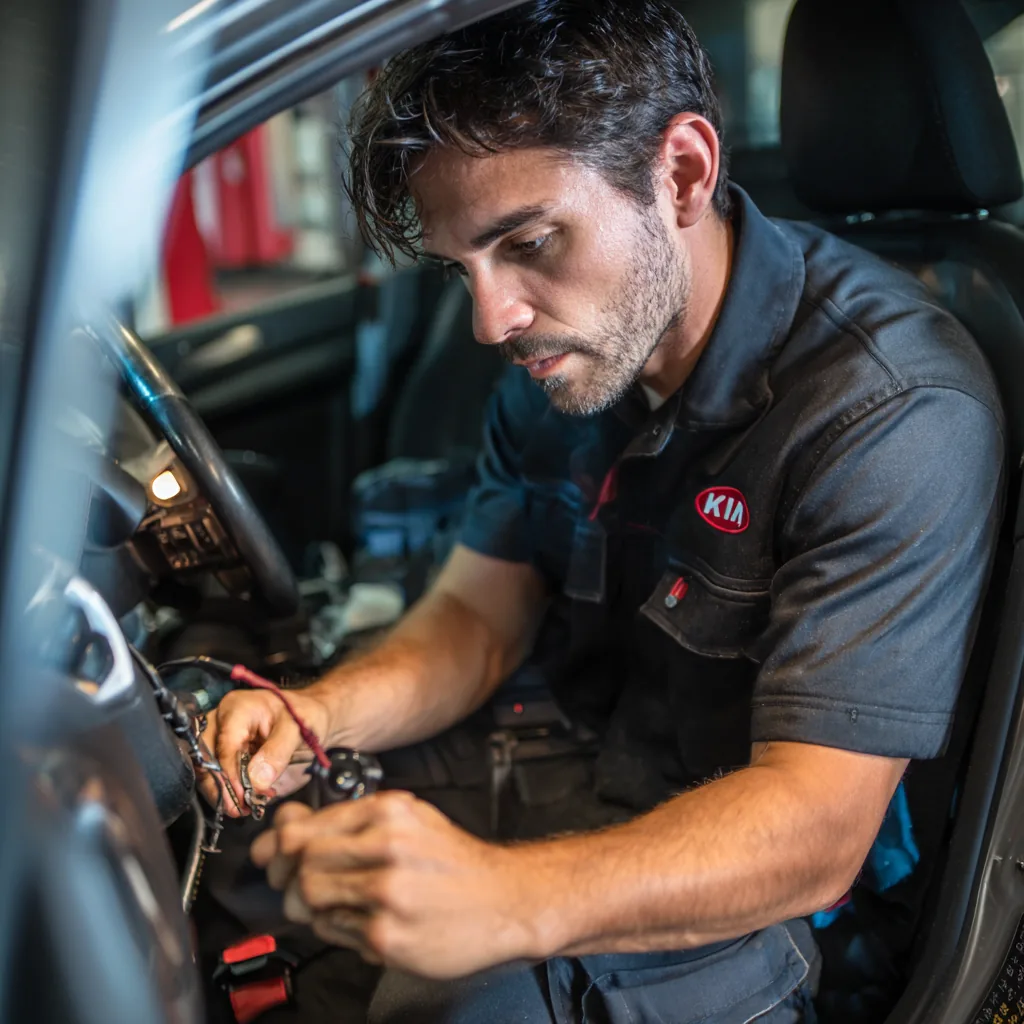
Automotive rekey. Far more complex because modern vehicles have two independent security systems: the mechanical lock cylinder in the ignition (similar in principle to a residential lock, with pin or wafer mechanisms) AND the electronic immobilizer module that verifies the key’s transponder chip before allowing the engine to start. “Rekeying” a car can mean either or both: replacing the ignition cylinder with one keyed to a new mechanical pattern, AND/OR reprogramming the immobilizer to recognize a new transponder credential. For most modern vehicles, both have to happen together — a mechanical-only rekey leaves the immobilizer rejecting the new key.
The asymmetry: residential rekey is a pure mechanical operation; automotive rekey is mechanical + electronic with required programming. This is why the trades have diverged and why the credentials differ. An ALOA-CML residential specialist has deep pin-tumbler expertise but typically no immobilizer programming capability. An ALOA-MAL automotive specialist has deep programming and ignition-cylinder expertise but typically doesn’t carry residential pinning kits.
When you need a residential rekey
You moved into a new home (own or rent). The previous occupants and anyone they gave keys to (cleaners, contractors, family, neighbors) still have working keys. Rekeying all exterior locks resets the trust circle. Per BBB consumer guidance, this is the #1 most common reason for residential rekey calls and a recommended best practice for new homeowners.
You had a security incident — break-in, lost keys, suspected unauthorized copy. Rekeying removes any risk that a copy made by an unauthorized party will work. Faster and cheaper than full lock replacement.
You want all your home locks keyed to a single key (key-alike). If you have a front door deadbolt, back door deadbolt, and garage entry deadbolt all using different keys, a residential locksmith can rekey them all to a single shared key. Simpler key management.
You’re an apartment landlord or property manager doing tenant turnover. Standard practice between tenants. Often paired with key-alike configurations for the property management to access multiple units.
You’re a small business owner with employee turnover. Commercial rekey for offices, retail spaces, etc. Often handled by commercial-specialist locksmiths who do master-key system design.
Typical cost in Grand Prairie 2026: $25-$50 per lock plus a trip fee ($35-$75). A full-home rekey for a 3-deadbolt house typically lands at $125-$225 all-in.
When you need an automotive rekey or ignition work
Your ignition cylinder is worn out and the key won’t turn (or only turns intermittently). Years of insertion and rotation wear down the cylinder’s internal wafers or pins. The fix is a new ignition cylinder, cut to match your existing key (or a new key cut to match a new cylinder), plus reprogramming the immobilizer if the new cylinder includes a chip-equipped lock body. Cost: $150-$400 depending on vehicle.
You bought a used vehicle and want fresh keys with the old ones de-registered. Less common than residential rekey but a legitimate use case. The mechanic-equivalent: originate new transponder keys, program them to the immobilizer, then de-register the previous keys so they no longer start the vehicle. Effectively a full key-system rekey for the vehicle. Cost: $200-$500 depending on vehicle.
You lost all keys and want the immobilizer reset so any old keys (if found) can’t be used. The all-keys-lost workflow for modern vehicles includes an immobilizer reset that flushes the previous key registrations. New keys programmed; old keys can’t start the vehicle even if found. Cost: same as all-keys-lost origination ($250-$800+ depending on vehicle).
A broken key got stuck in your ignition. Extraction + ignition cylinder repair. Mobile automotive locksmith with proper tooling can handle this in 45-90 minutes typically. Cost: $150-$350.
Your vehicle’s ignition switch (not the cylinder itself) failed and the engine won’t start. Mechanical/electrical work specific to your vehicle’s ignition assembly. Sometimes pairs with module-level diagnostic work. Cost: $200-$500.
What an automotive rekey actually involves
Take the most common automotive rekey scenario: a worn ignition cylinder on a 2014 Toyota Camry where the key has become hard to turn. Workflow:
(1) Diagnosis. Confirm the issue is cylinder wear (not key wear, not steering column lock, not battery issue). Test the key in adjacent doors to isolate the problem to the ignition specifically. Verify the mechanical key blade isn’t bent or worn beyond spec.
(2) Cylinder access. Remove the steering column shroud to access the ignition lock assembly. The exact procedure varies by vehicle — some cylinders pull out with a special tool, others require disassembling adjacent components. This step is where the technician’s vehicle-specific expertise matters.
(3) Cylinder replacement. Install a new ignition cylinder. For most 2010+ vehicles, the new cylinder must include the chip-equipped lock body that the immobilizer can read. The new cylinder is cut to match the existing key (or a new key cut to match the cylinder, customer’s choice).
(4) Immobilizer pairing. If the new cylinder includes a chip antenna, the antenna may need to be paired with the existing transponder. If a new key is being cut, the new transponder is paired with the immobilizer. This is the step where NASTF VSP credentials matter for post-2010 vehicles.
(5) Verification. Test the key in the new cylinder. Confirm smooth rotation. Confirm engine starts. Confirm any old keys still work (if they’re being preserved) or that they no longer work (if being de-registered).
(6) Reassembly. Reinstall the steering column shroud and any other components removed during cylinder access. Verify all warning lights are off, all buttons function.
Total time on-site for an experienced automotive technician: 60-120 minutes for most mainstream vehicles. For European luxury or older vehicles with unusual ignition assemblies: 90-180 minutes.
What a residential rekey actually involves
Take the most common residential rekey scenario: a homeowner moving into a 4-bedroom house with three exterior locks (front door deadbolt, back door deadbolt, garage entry door deadbolt). Workflow:
(1) Cylinder removal. Remove each deadbolt cylinder from the door. For most modern residential locks (Schlage, Kwikset, Yale), this involves removing the lock face screws and pulling the cylinder. Total time: 5-10 minutes per lock.
(2) Pinning. Open the cylinder housing, remove existing pins and springs, install new pins keyed to a new key cut, reinstall springs. The pinning kit contains pre-sized pins for the major lock brands. A skilled residential locksmith can pin a standard 5-pin cylinder in 5-8 minutes.
(3) Verification. Test the new key in the cylinder before reinstalling. Confirm smooth rotation, proper engagement, no binding. Test that old keys no longer work.
(4) Reinstallation. Reinstall the cylinder in the deadbolt, secure with face screws, verify smooth operation in the door.
(5) Multi-lock key-alike (if requested). When multiple locks need to share a single key, all cylinders get pinned to the same key cut. Adds time but typically not cost above the per-lock rekey rate.
Total time on-site for a residential locksmith: 30-60 minutes for a typical 3-lock rekey. Tools: pinning kit ($150-$300 retail), a follower tool ($15), a key duplicator (sometimes), patience. No diagnostic equipment, no programming software, no NASTF credentials.
The deeper reason these trades stay separate
Tooling investment. A residential rekey specialist needs a pinning kit, a follower tool, a key duplicator, and a small workshop bench — total tool investment well under $1,000. An automotive locksmith needs OBD-II diagnostic equipment, transponder programmers, key cutters (mechanical and laser), and BENCH/BOOT mode programmers — total tool investment $25,000-$40,000+. The economics of carrying both fully-equipped toolsets full-time don’t pencil out for most operators.
Continuing education cadence. Residential lock standards change slowly — pin tumbler mechanics haven’t fundamentally changed since the 1850s; smart-lock products evolve but the underlying mechanical principles are stable. Automotive immobilizer technology changes per model year — BMW’s shift from CAS3 to CAS4 to FEM to BDC, Mercedes-Benz’s EIS pairing changes, Toyota’s DST-AES migration. A working automotive locksmith spends 50-100 hours per year on continuing education to stay current.
Service economics. Residential rekey is a $100-$300 service call typically. Automotive rekey or all-keys-lost work is $250-$1,000+ per service call. The unit economics and operational model differ enough that specializing in one rather than diluting across both produces better results within scope.
Customer outcomes. Per Salesforce State of Service research, first-call resolution correlates strongly with customer satisfaction. Specialists within their declared scope deliver first-call resolution more reliably than generalists across both domains. The trade-off — specialists can’t help with adjacent work — is the right structural choice when adjacent work is genuinely a different specialty.
A Real-World Example
Operator: A Grand Prairie family who moved into a new home in early 2026. Had three pieces of locksmith work needed: (1) rekey all three exterior deadbolts on the new house, (2) ignition cylinder replacement on their 2013 Subaru Outback that had become hard to turn, (3) spare smart key for their 2020 Honda CR-V.
Before:
- Initial impulse: hire one "locksmith" to do all three jobs in a single visit.
- Called a generalist who advertised "residential and automotive — we do it all."
- Generalist arrived, did the residential rekey adequately (~$185 for the three deadbolts). When it came to the Subaru ignition cylinder, didn’t carry the right replacement cylinder for the 2013 Outback. Couldn’t program the Honda smart key — no Autel-class diagnostic equipment in the van.
- Net: only one of three jobs completed on the first visit. Two follow-up appointments needed with different specialists.
What changed:
Family realized the trades were different. Booked: (a) the same residential locksmith for any future home work, and (b) an ALOA-MAL automotive specialist for both the Subaru ignition and the Honda smart key. The automotive specialist handled both vehicle jobs in a single 2-hour visit at the family’s home.
Results:
- Residential rekey (3 deadbolts, key-alike): $185 all-in, completed in single visit, residential locksmith
- Subaru ignition cylinder replacement: $295 all-in, completed in 80 minutes, automotive specialist
- Honda CR-V spare smart key: $245 all-in, completed in 35 minutes, automotive specialist (same visit as Subaru)
- Total: $725 across three jobs, completed in two specialist visits instead of three+ generalist visits
Net: The single-generalist instinct cost the family ~3 weeks of partial-resolution friction. The specialist-per-trade approach completed everything in two well-scoped visits with no follow-up needed. Pattern is consistent: specialists outperform generalists within their declared scope, especially when scope spans residential AND automotive locksmith work. Both ALOA’s certification taxonomy and first-call-resolution research support this framing.
What Experts Say
“The reason a single locksmith claiming to do top-tier residential and top-tier automotive rekey work is rare is that the toolset investment and continuing education burden of both is functionally a full-time commitment in each domain. Operators who try to maintain both at high tier usually run multi-technician operations. Solo operators rationally specialize. The good news is that finding a specialist in either domain is straightforward once you know which trade you actually need.”
Per ALOA’s separate MAL and CML certification ladders, these are recognized as distinct specialties with different examination paths. The trade body itself acknowledges the divergence; customers benefit by matching the specialist to the problem. This pattern is consistent with the broader service-industry research on first-call resolution and customer satisfaction.
Frequently Asked Questions
Do you rekey homes?
No — we’re an automotive-only mobile locksmith. We rekey ignition cylinders, program new transponder keys to the vehicle’s immobilizer, and handle all-keys-lost workflows. For home rekeying (deadbolts, door locks), you want a residential locksmith. The <a href="https://www.aloa.org/" target="_blank" rel="noopener">ALOA member directory</a> can help you find one in Grand Prairie.
What does it cost to rekey a car ignition in Grand Prairie?
For mainstream vehicles (Toyota, Honda, Ford, GM, Hyundai, Kia), ignition cylinder replacement runs $150-$400 typically, including labor, the new cylinder, and any required programming. For European luxury, $300-$600 is more typical due to higher cylinder costs and additional module-level programming requirements. Call us with your year/make/model for a specific quote.
Why does rekeying a car cost more than rekeying a home?
Different work. A home rekey involves changing 5-6 small pins inside a deadbolt cylinder — 15 minutes per lock with $5 in parts. A car rekey involves replacing or repinning an ignition cylinder + reprogramming the vehicle’s immobilizer to recognize the new key — 60-120 minutes with $50-$200 in parts and $25,000+ in diagnostic equipment to access the immobilizer system. The work is genuinely more involved.
Can I rekey a car so my old keys no longer start it?
Yes — for modern vehicles, this is done by reprogramming the immobilizer to de-register the old keys and register new ones. The mechanical lock can also be rekeyed if you want a different physical key pattern. Common scenario after buying a used vehicle where you want to ensure the previous owner’s keys can’t start the vehicle. Mobile automotive locksmith with NASTF VSP credentials.
Is rekeying a home cheaper than replacing the locks?
Almost always yes. Rekeying typically runs $25-$50 per lock plus a trip fee. Lock replacement (buying new hardware + installation) typically runs $80-$200 per lock plus installation labor. For a 3-lock home, rekeying lands at $100-$200 vs. lock replacement at $300-$600+. The exception: if your existing locks are damaged or low-quality, replacement may be the better long-term value.
How long does an ignition cylinder rekey take?
For mainstream vehicles, typically 60-120 minutes on-site. Factors: vehicle make/model, age of the vehicle (older cylinders sometimes seize and require more removal effort), whether the new cylinder requires immobilizer reprogramming. A competent mobile automotive technician completes most ignition cylinder work in a single visit at the customer’s location.
The Bottom Line
Rekeying a car and rekeying a home are different services from different trades. Home rekey = pin tumbler swap inside residential deadbolts ($100-$225 typical for a 3-lock home, residential locksmith). Car rekey = ignition cylinder replacement plus immobilizer reprogramming ($150-$500 typical, automotive locksmith with NASTF VSP). Find the specialist matching your specific problem — generalists who claim top-tier capability in both are uncommon and worth additional vetting.
Next Steps
For automotive ignition work, key programming, or all-keys-lost rekey in Grand Prairie, see our ignition repair page and key programming page. Call (214) 949-1847 with your vehicle year/make/model and a description of the issue for a quote. For residential rekey work, check the ALOA member directory for a Grand Prairie residential specialist.