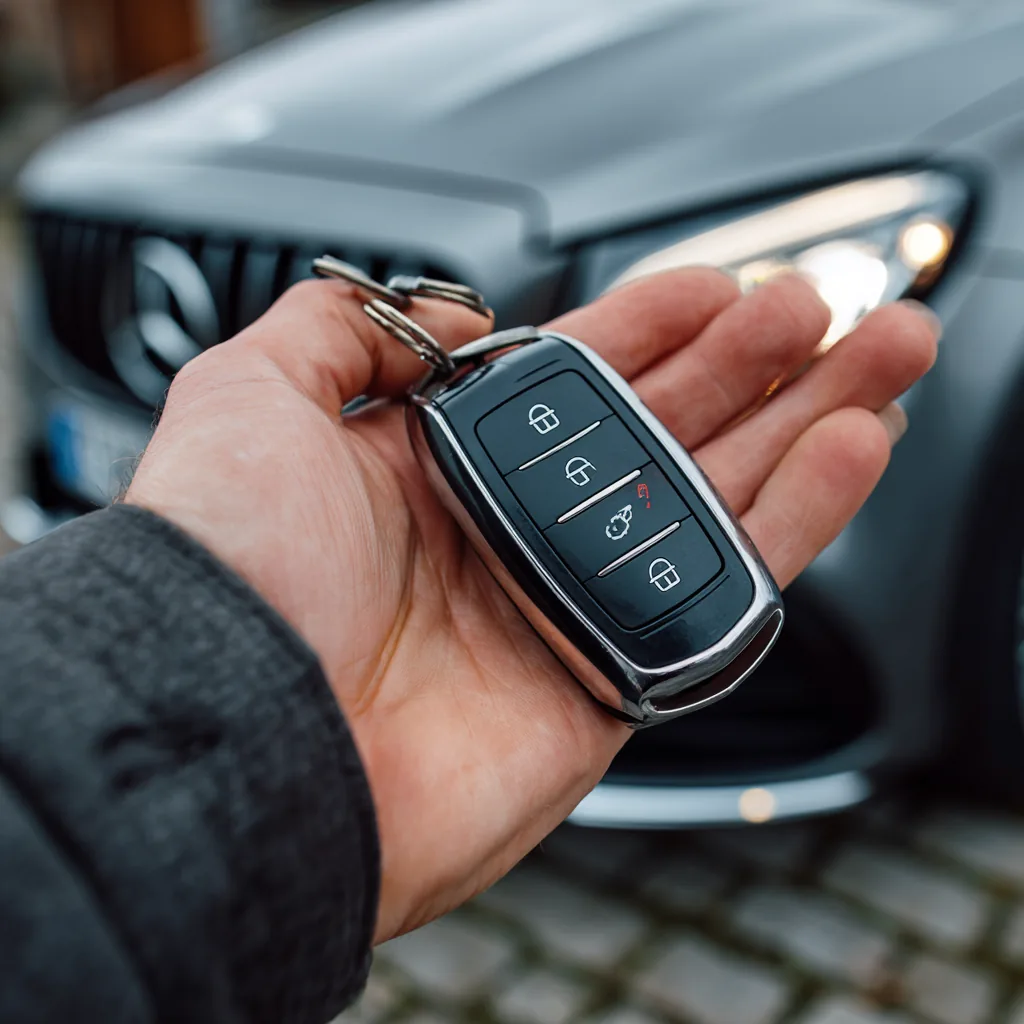
The cost comparison — real numbers for 2026
Here’s the all-in pricing for the most common car key replacement scenarios in Grand Prairie / DFW in 2026, comparing a competent mobile automotive locksmith (ALOA-MAL + NASTF VSP) to the manufacturer’s authorized dealer service department.
2015 Honda Civic, replacement transponder key (have a working key, want a spare). Locksmith: $135-$185 all-in, on-site, ~30 minutes. Dealer: $250-$350 plus the cost of getting the vehicle to the dealer.
2018 Toyota Highlander, smart key origination (lost all keys). Locksmith: $315-$415 all-in, on-site, 75-110 minutes. Dealer: $550-$700 + tow cost (typically $100-$200) + 2-4 day service department wait.
2019 Ford F-150, push-start smart key replacement. Locksmith: $285-$385 all-in. Dealer: $475-$625 + tow if all keys lost.
2020 BMW X3 (G-series), smart key all-keys-lost with CAS4/FEM module work. Locksmith (Tier 3): $475-$725 all-in. Dealer: $850-$1,200+ depending on the service department’s flat-rate pricing.
2019 Mercedes-Benz GLC, smart key with EIS pairing. Locksmith (Tier 3): $525-$825 all-in. Dealer: $950-$1,400+.
2020 Range Rover Sport, all-keys-lost smart key. Locksmith (Tier 3): $625-$925 all-in. Dealer: $1,100-$1,650+.
Per AAA’s vehicle ownership cost research, mobile automotive locksmith pricing consistently lands 35-60% below dealer pricing for equivalent work. The gap is structural — locksmiths have lower overhead (no service-bay rent, smaller back-office), more streamlined workflows, and the unit economics of mobile dispatch rather than scheduled service-department appointments.
The time comparison — when "fast" matters most
For an everyday key situation — lost one key, have the other — you can usually wait a few days. For an all-keys-lost case where the vehicle won’t start, time is the bigger variable.
Dealer service-department workflow for all-keys-lost. (1) Tow vehicle to dealer (1-3 hours depending on availability and time-of-day). (2) Schedule a service appointment (typically 1-3 business days out — same-day key origination is rare even at large dealerships). (3) Service department orders the key from manufacturer (1-3 business days if not in inventory; some dealers keep common keys in stock). (4) Key cut and programmed at dealership (1-4 hours of service-bay time). Total elapsed time from lockout to driveable vehicle: typically 3-7 business days.
Mobile locksmith workflow for all-keys-lost. (1) Phone call confirms vehicle and quote (5-10 minutes). (2) Technician dispatches to vehicle’s current location (15-60 minutes depending on traffic and distance). (3) Technician originates and programs the key on-site (60-150 minutes depending on complexity). Total elapsed time from phone call to driveable vehicle: typically 2-4 hours.
For drivers who depend on their vehicle for work, the time difference compounds. The dealer path implies 3-7 working days of rental car, rideshare, or missed work — at $80-$200/day, that’s an additional $240-$1,400 of indirect cost on top of the higher dealer price for the key itself.
Per Salesforce State of Service research, time-to-resolution is consistently the strongest predictor of customer satisfaction in service-industry research. Mobile-locksmith time-to-resolution outperforms dealer service-department time-to-resolution by 5-20x in the all-keys-lost scenario.
The capability comparison — when each wins
What an ALOA-MAL + NASTF VSP credentialed mobile locksmith handles confidently: almost all key work on mainstream domestic, Asian, and European vehicles from roughly 1998 through current. This includes routine transponder duplication, smart-key origination, all-keys-lost cases on mainstream and European luxury (BMW, Mercedes-Benz, Audi, Range Rover, Porsche), push-start systems, ignition cylinder replacement, and key extraction. The diagnostic toolset (Autel IM608, AVDI, Xhorse VVDI BMW/MB tools, etc.) covers the OEM workflows that NASTF VSP makes accessible.
Where the dealer specifically wins:
1. Warranty-covered work. If your vehicle is under factory warranty or a service contract that requires dealer-completed work to maintain coverage, you have to go to the dealer for warranty-covered service. Most key work is NOT warranty-covered (keys are typically considered wear/loss items), but if your specific situation involves a warranty claim, the dealer is the right path.
2. Very-current model years (typically first 6-12 months). When a new vehicle platform launches, aftermarket tool vendors (Autel, AVDI, Xhorse) need 6-12 months to develop and validate the diagnostic workflow for the new platform. During that window, the dealer’s OEM tooling is sometimes the only viable path. By Q3 or Q4 after a platform launch, aftermarket tooling has usually caught up.
3. Certain limited-production or specialty vehicles. Bentley, Maserati, McLaren, Rolls-Royce, low-volume Aston Martin, certain limited-edition Porsches. The aftermarket tooling for these is thinner because the unit volumes don’t justify the vendor investment. For these vehicles, the dealer remains the safer path.
4. Tesla, Rivian, Lucid for first-time customer setup. EV manufacturers have moved away from traditional key fobs toward phone-key + key-card systems. Initial customer setup is typically dealer-completed. Replacement key cards can be ordered by the customer directly from the manufacturer rather than going through a locksmith.
5. Vehicles where the customer cannot prove ownership. A NASTF VSP locksmith will decline to originate keys for a vehicle without registration/title proof. The dealer can sometimes work with you on documentation if you’ve lost paperwork and the vehicle is registered in your name. Rare but real scenario.
The trust comparison — what each side has to lose
The dealer service department. Operates under franchise agreements with manufacturers, follows brand standards, has documented warranty work, and has continuity at a physical address. If something goes wrong, you have clear recourse — the dealer can’t disappear overnight without losing the franchise. The trade-off: dealer service departments are profit centers for the dealer, often the highest-margin part of the operation, which is why pricing tends to be higher.
A mobile automotive locksmith. Operating under ALOA and NASTF VSP credentials, accountable through professional certifications (which can be revoked for misconduct), often locally-owned with reputational stakes in the community. The accountability is real but more distributed across multiple oversight mechanisms. The trade-off: mobile operators have less overhead but vary more in capability — vetting through credentials, written quotes, and local reputation is the customer’s responsibility.
The bait-pricing operator. Operates under flexible business names, sometimes routes through national 1-800 dispatchers, has no skin in the game on long-term reputation. This is the failure mode that hurts the trade’s reputation — and the one the FTC consumer-protection guidance flags. Per FTC’s locksmith scam advisory, the defensive playbook for customers is: verify credentials, get written prices before dispatch, confirm a real local presence.
The honest framing for trust: a reputable mobile automotive locksmith and a dealer service department are both viable trusted paths. They differ in price, speed, and convenience — not fundamentally in trustworthiness when the locksmith is properly credentialed.
The hidden cost of the dealer path — opportunity cost
The headline price comparison (locksmith vs. dealer service department) understates the dealer path’s true cost because it leaves out the opportunity cost of being without a working vehicle.
Tow cost. An all-keys-lost case at home or roadside requires a tow to the dealer. DFW area towing typically runs $100-$200 per tow, depending on distance and time-of-day. For after-hours or weekend towing, it can be more.
Rental car. If the vehicle has to sit at the dealer for 2-7 days, you’re renting a car or paying for rideshare. Conservative estimate: $40-$60/day for a basic rental, $20-$80/day for rideshare depending on usage pattern.
Missed work or lost productivity. If your vehicle is required for your work (gig drivers, sales reps, contractors, delivery), every day without the vehicle is direct lost income. This varies widely but can be the single largest hidden cost.
Stress and friction. Coordinating tows, calling rental companies, dealing with multiple service-department interactions, picking up the vehicle when ready. Hard to dollar-value but real.
For a typical all-keys-lost smart-key situation, the all-in dealer path with these hidden costs often lands $400-$800+ higher than the headline price difference suggests. The mobile-locksmith path eliminates almost all of these because the work happens at the vehicle’s current location in the same day.
How to decide for your specific situation
A decision framework based on five questions:
1. Is the vehicle under factory warranty AND is the key work warranty-covered? If yes to both, go to the dealer. (Most key work isn’t warranty-covered, but confirm your specific situation.)
2. Is the vehicle a 2024+ brand-new-platform model from a manufacturer that aftermarket tooling hasn’t caught up to yet? If yes, check whether your specific year/make/model is supported by an ALOA-MAL specialist with current tooling before committing — and if not, dealer is the fallback. By 2026, most current platforms have aftermarket support.
3. Do you drive a specialty/limited-production vehicle (Bentley, Maserati, McLaren, Rolls-Royce, very-low-volume models)? If yes, the dealer is generally safer.
4. Is the vehicle a Tesla, Rivian, or Lucid AND is this initial customer setup? If yes, the OEM/dealer path is typically required.
5. None of the above apply? The mobile-locksmith path almost always wins on cost, time, and convenience. Vet the locksmith using the five-step phone checklist (credentials, written price, technician location, vehicle capability, payment terms) and proceed.
For the majority of car key situations in Grand Prairie / DFW, the answer to question 5 is yes — none of the dealer-specific conditions apply, and the mobile locksmith path is the operationally correct choice.
A Real-World Example
Operator: A Grand Prairie household with two vehicles — a 2019 Toyota Sienna (family minivan, primary daily driver) and a 2017 BMW 5-Series (commuter sedan). The Sienna’s primary smart key was lost during a family trip; the BMW’s second key was misplaced and the household wanted a replacement.
Before:
- Sienna situation: had a single working key, needed a spare smart key as a backup.
- BMW situation: had a working primary key, needed a replacement for the misplaced second key (CAS3-equipped 2017 5-Series).
- Initial instinct: take both to the respective dealers. Toyota dealer service department quoted ~$385 for the Sienna smart key (with appointment 4 days out). BMW dealer service quoted ~$675 for the 5-Series CAS3 key (with appointment 7 days out due to service-department backlog).
- Total dealer-route estimate: $1,060 + 7+ days of single-key risk during the wait.
What changed:
Household called a mobile automotive locksmith (ALOA-MAL + NASTF VSP). Confirmed both vehicles by year/make/model. Quoted Sienna at $245 all-in and BMW at $445 all-in, written quotes provided within 10 minutes. Scheduled a Saturday morning appointment — both vehicles serviced back-to-back in the driveway.
Results:
- Total locksmith bill: $690 ($245 Sienna + $445 BMW)
- Total elapsed time on-site: 2 hours 50 minutes for both vehicles
- Vehicles never left the driveway
- Saved vs. dealer-route estimate: $370 on the headline price comparison, plus avoided 7+ days of single-key risk on the BMW
Net: Net difference: roughly $370 saved on direct pricing plus the qualitative win of completing both jobs in a single Saturday-morning service window rather than coordinating two separate dealer appointments across two weeks. Pattern is repeatable: for two-vehicle or multi-vehicle households where neither vehicle is under active warranty key work, the mobile-locksmith path consistently outperforms the dealer-route alternative — confirmed by AAA’s comparative repair cost data.
What Experts Say
“I used to push every key-replacement customer to the dealer because that was the conservative answer in 2010. By 2018 the calculus had completely flipped — aftermarket tooling caught up, NASTF VSP made OEM data access legitimate, and the mobile workflow became operationally better. For 2026, the only customers I send to the dealer are warranty cases or very-new platform launches in the first six months.”
Per AAA’s comparative repair cost research and Salesforce State of Service customer-satisfaction research, the mobile-locksmith path now outperforms dealer service departments on cost and time-to-resolution for the majority of automotive key work, with specific carve-outs for warranty cases and very-new model years.
Frequently Asked Questions
Are mobile locksmith keys the same quality as dealer keys?
For most mainstream vehicles, yes — competent automotive locksmiths use OEM or OEM-equivalent key blanks and identical programming workflows. The chip in the key and the immobilizer pairing are the same regardless of who installs them. The difference is the cost of getting the work done, not the quality of the work itself.
Will using a locksmith void my warranty?
Generally no, for key work specifically. Key replacement is typically considered a wear/loss item, not a covered warranty repair. The Magnuson-Moss Warranty Act protects consumers from having warranties voided for using independent service providers for non-warranty work. That said, if you have a specific warranty term or service contract, read it — and ask the dealer for the specific clause if you’re unsure.
Can a locksmith program a key for a brand-new car?
Sometimes yes, sometimes not yet. For the first 6-12 months after a new vehicle platform launches, aftermarket tool vendors are still developing the diagnostic workflow. During that window, the dealer may be the only viable path. By the time a platform has been in market for a year, ALOA-MAL specialists with current tooling have generally caught up. Ask specifically about your year/make/model — a competent locksmith will tell you straight if they don’t have your platform yet.
What if I need a key right now and the dealer is closed?
Mobile automotive locksmiths typically offer same-day and after-hours dispatch. Most dealer service departments don’t. For a late-evening or weekend emergency, the mobile-locksmith path is usually the only viable option — and the price difference vs. waiting for the dealer to open the next business day is significant once you factor in the cost of being without your vehicle overnight.
What about Costco / Sam’s Club automotive services — can they replace car keys?
Generally no for modern programming-required keys. Big-box auto departments handle tires, batteries, oil changes, and similar high-volume work. Key programming is too specialized and tool-dependent for the big-box service model. For programming-required keys, your two viable paths are mobile locksmith or dealer service department.
Is the dealer ever cheaper than a locksmith?
Very rarely. The pricing pattern is consistent across mainstream and European luxury — mobile automotive locksmiths run 35-60% below dealer pricing for equivalent work. The exception would be a dealer running a promotional/loss-leader price on a specific key service, which is rare and usually limited-time. In the standard pricing comparison, the locksmith wins on cost every time.
The Bottom Line
For the overwhelming majority of car key replacement situations in Grand Prairie in 2026, a mobile automotive locksmith with ALOA-MAL credentials and NASTF VSP registration beats the dealer service department on cost (35-60% less), time-to-resolution (hours vs. days), and convenience (no tow required). The dealer specifically wins on warranty-covered work, very-current model-year platforms, certain specialty vehicles, and initial Tesla/Rivian/Lucid setup. For everything else — and that’s most situations — the mobile-locksmith path is the operationally correct choice.
Next Steps
For a car key replacement quote in Grand Prairie, call (214) 949-1847 with your vehicle year/make/model — we’ll quote the all-in total before dispatch so you can compare to your dealer’s pricing directly. Also see our car key replacement service page and lost car key page.