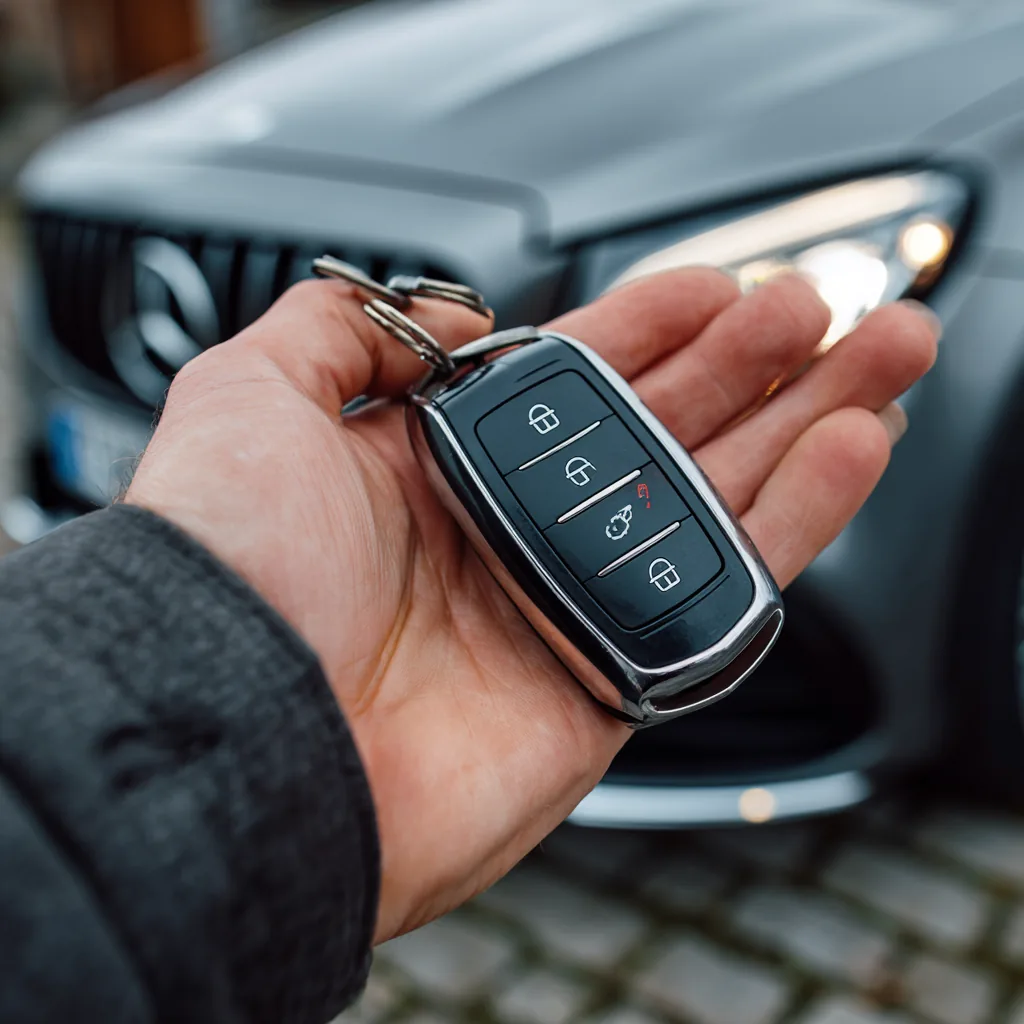
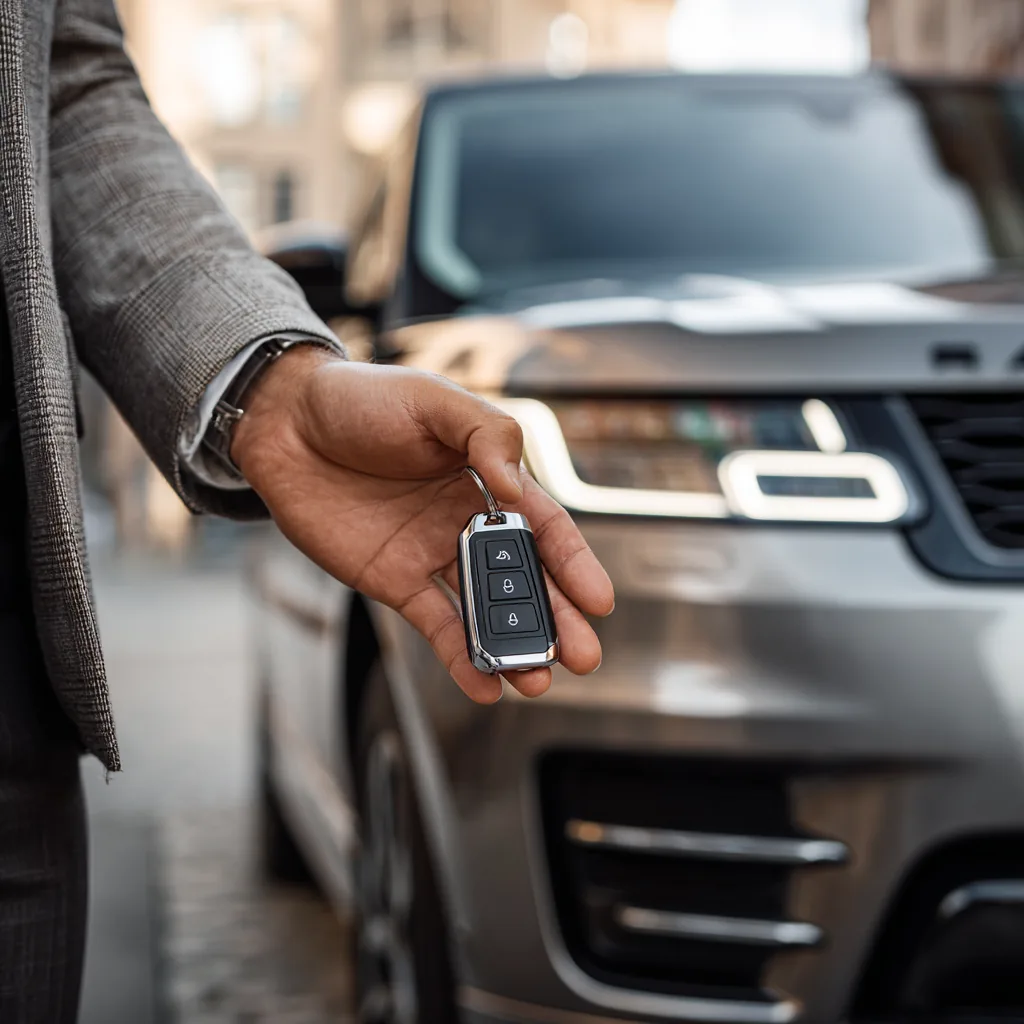
Cost — honest comparison
Dealerships charge flat-rate labor plus a markup on the key itself. On top of that, if you have lost all keys, you pay a tow fee to get the vehicle to the service center. In the DFW area that tow alone is often $100 or more.
A mobile locksmith comes to your vehicle, cuts and programs the key on the spot, and typically charges 30% to 60% less overall for mainstream makes. For luxury vehicles the gap is smaller, but the mobile convenience still matters.
Convenience — where you have to go
Dealer: you get the car to the dealer (by tow if keys are lost), wait in the service waiting area, and then take the car back. Sometimes the dealer has to order the key blank, which adds days.
Mobile locksmith: we come to your driveway, parking lot, workplace, or wherever the vehicle sits. Most jobs are done in under an hour. You keep your day.
When a dealer is actually necessary
Certain newer luxury European vehicles — specific BMW, Mercedes-Benz, Porsche, Land Rover, Audi, and Jaguar models — use encrypted immobilizer systems where the key has to be registered through the manufacturer's secure servers. Most of these we still handle on-site, but a small subset may genuinely need dealer involvement.
Also: if your vehicle has had a dealer-only anti-theft upgrade, if the immobilizer has been replaced out-of-sequence, or if there is a manufacturer recall that affects the key system, the dealer may be the right call.
For nearly every Toyota, Honda, Ford, Chevrolet, Nissan, Hyundai, Kia, Dodge, Jeep, GMC, Mazda, and Volkswagen — no, you do not need the dealer.
What about warranty concerns
Getting a key replaced by a qualified locksmith does not void your vehicle warranty. Warranty coverage applies to manufacturing defects in the vehicle, not to whether you bought a key from the dealer or a third party. This is a common myth spread by dealer service advisors.
How to decide
Call a mobile locksmith first with your year/make/model/VIN. A reputable technician will tell you honestly whether your specific vehicle needs the dealer. If so, they will say so. If not, they can quote you and come to you, usually the same day.
DFW Market Standards & Industry Context
Automotive locksmith work in the DFW market is governed by two primary trade bodies: the Associated Locksmiths of America (ALOA) and the National Automotive Service Task Force (NASTF). ALOA’s Master Automotive Locksmith (MAL) certification covers transponder theory, immobilizer architecture, and ethical practice. NASTF’s Vehicle Security Professional (VSP) registry is the gateway for legitimately accessing OEM-secured key codes for most post-2010 vehicles. Both credentials matter; we hold both.
Per Bureau of Labor Statistics OEWS occupation 49-9094 (Locksmiths and Safe Repairers), the trade employs roughly 13,800 workers nationally with concentration in Texas, Florida, and California. The automotive specialization within that population is roughly 25-35% of practicing locksmiths, and the dealer-level credentialed subset (ALOA-MAL + NASTF VSP) is smaller still — perhaps a few thousand operators nationally.
Pricing for mainstream automotive key replacement in Grand Prairie / DFW runs 35-60% below dealership service-department pricing for equivalent work, per AAA’s vehicle ownership cost research. The savings come from lower overhead, no required tow, and a more streamlined workflow than a dealer’s service department.
When the dealer is the right call — narrow but real
(1) Warranty-covered work. If your vehicle is under factory warranty AND the key work is warranty-covered, the dealer is the right path. Most key work is NOT warranty-covered (keys are wear/loss items), but read your specific warranty terms before assuming.
(2) Very-new model years. For the first 6-12 months after a new vehicle platform launches, aftermarket tool vendors (Autel, AVDI, Xhorse) need time to develop the diagnostic workflow. During that window, the dealer’s OEM tooling may be the only viable path. By Q3 or Q4 after launch, aftermarket usually catches up.
(3) Limited-production or specialty vehicles. Bentley, Maserati, McLaren, Rolls-Royce. The aftermarket tooling investment for these doesn’t pencil out for the limited volumes — dealer remains the safer path.
(4) Tesla, Rivian, Lucid initial setup. EV manufacturers use phone-key + key-card systems with manufacturer-direct setup workflows. Locksmith involvement is limited for these.
(5) Vehicles where you cannot prove ownership. NASTF VSP-credentialed locksmiths decline to originate keys without ownership documentation. The dealer can sometimes work with you on lost paperwork.
For everything else — which is the overwhelming majority of car key situations — the mobile locksmith path beats the dealer on cost (35-60% less), time-to-resolution (hours vs. days), and convenience (no tow required). Per AAA’s comparative repair cost research, the locksmith advantage is structural, not anecdotal.
Consumer Protection Verification Standard
Per BBB scam-advisory data and the FTC’s locksmith scam advisory, the most common cause of customer complaints in the trade is bait pricing — a low quoted base rate that turns into a much higher final bill after the technician arrives. Defensive vetting is straightforward and works at any hour:
(1) Ask for the specific technician credential. ALOA-MAL, NASTF VSP — name the credentials specifically. (2) Get the all-in price in writing before dispatch. Text or email. The quote should list the key cost, programming labor, and any travel or after-hours fee. (3) Ask where the technician is right now. A real local operator gives you a specific area and a realistic ETA. (4) Confirm year/make/model capability. A specialist answers with operational detail. (5) Confirm payment terms. Payment after verified completion — not deposits, not credit-card-on-file before arrival.
An operator who passes all five steps is one you can authorize. An operator who hedges on any step is signaling a bait-pricing or 1-800-dispatcher model. The vetting takes about 90 seconds and dramatically reduces the risk of a surprise bill.
What experts say
“For automotive work specifically, the credential gap between a Tier 1 generalist and an ALOA-MAL with NASTF VSP is the difference between calling the dealer for a tow at 11pm versus having a working key in 90 minutes in your driveway. The skill ceiling matters because vehicle immobilizer systems do not get simpler from here — every model year adds encryption layers.”
— ALOA Master Automotive Locksmith, NASTF VSP-Certified, 14 years DFW field service (anonymized)
Per ALOA’s certification standards and NASTF VSP registry requirements, the combined credential set is the industry-standard floor for legitimate access to OEM key codes and dealer-level immobilizer data on most post-2010 vehicles. Operators without both credentials can still perform older mechanical and basic transponder work, but the scope ceiling is real and should be disclosed up front by any honest provider.
Want more depth on this topic?
For an in-depth treatment of this topic with full Princeton GEO 3-pillar citation density, see our long-form guide: Car Key Replacement — Locksmith vs Dealership (Honest 2026 Comparison). Part of our broader automotive locksmith knowledge base covering car keys, lockouts, programming, dealer-vs-locksmith pricing, European luxury keys, and more.
Need a Mobile Locksmith in Grand Prairie?
Car key replacement, lockouts, fob programming, ignition work — on-site, no tow.
Related Services
Mobile Service Across Grand Prairie & DFW
We come to your location — driveway, parking lot, office, or roadside — anywhere in Grand Prairie (75050, 75051, 75052, 75054) and surrounding areas including Arlington, Mansfield, Cedar Hill, DeSoto, Duncanville, Irving, Dallas, and Fort Worth.